
Seedance Pricing Strategy: Pay-as-You-Go vs Subscription by Use Case
This Seedance pricing guide explains when Pay-as-You-Go or Subscription is better, with practical usage scenarios, cost logic, and decision rules for creators and teams.
If you are deciding how to pay for video generation, the wrong plan can slow your workflow or waste budget.
A clear seedance pricing strategy is not about finding the cheapest number on the page. It is about matching payment mode to how you actually create.
This guide gives you a practical way to choose between Pay-as-You-Go and Subscription based on real use cases.
If you want to start testing while reading: Seedance AI Video Generator
TL;DR
- Good seedance pricing starts with your monthly output pattern.
- Use Pay-as-You-Go for irregular projects and campaign spikes.
- Use Subscription for predictable weekly production.
- Track credits and retries, not just raw clip count.
- Review your plan monthly as your workflow changes.
Why “Cheaper Plan” Thinking Often Fails
Most users compare plans only by headline price.
That misses the real seedance pricing question:
- Do you generate in bursts or every week?
- Do you run many iterations per idea?
- Do you work solo or with a repeatable team workflow?
A plan that looks cheap can become expensive if it does not match your behavior.
Core Comparison: Pay-as-You-Go vs Subscription
Use this table as your baseline decision frame.
| Model | Best for | Typical pattern | Main risk |
|---|---|---|---|
| Pay-as-You-Go | Flexible or project-based work | Uneven usage, campaign spikes | Unit cost can feel high at scale |
| Subscription | Ongoing production rhythm | Weekly or daily content output | Paying for capacity you do not use |
A practical seedance pricing decision should start from usage pattern first, not brand preference.
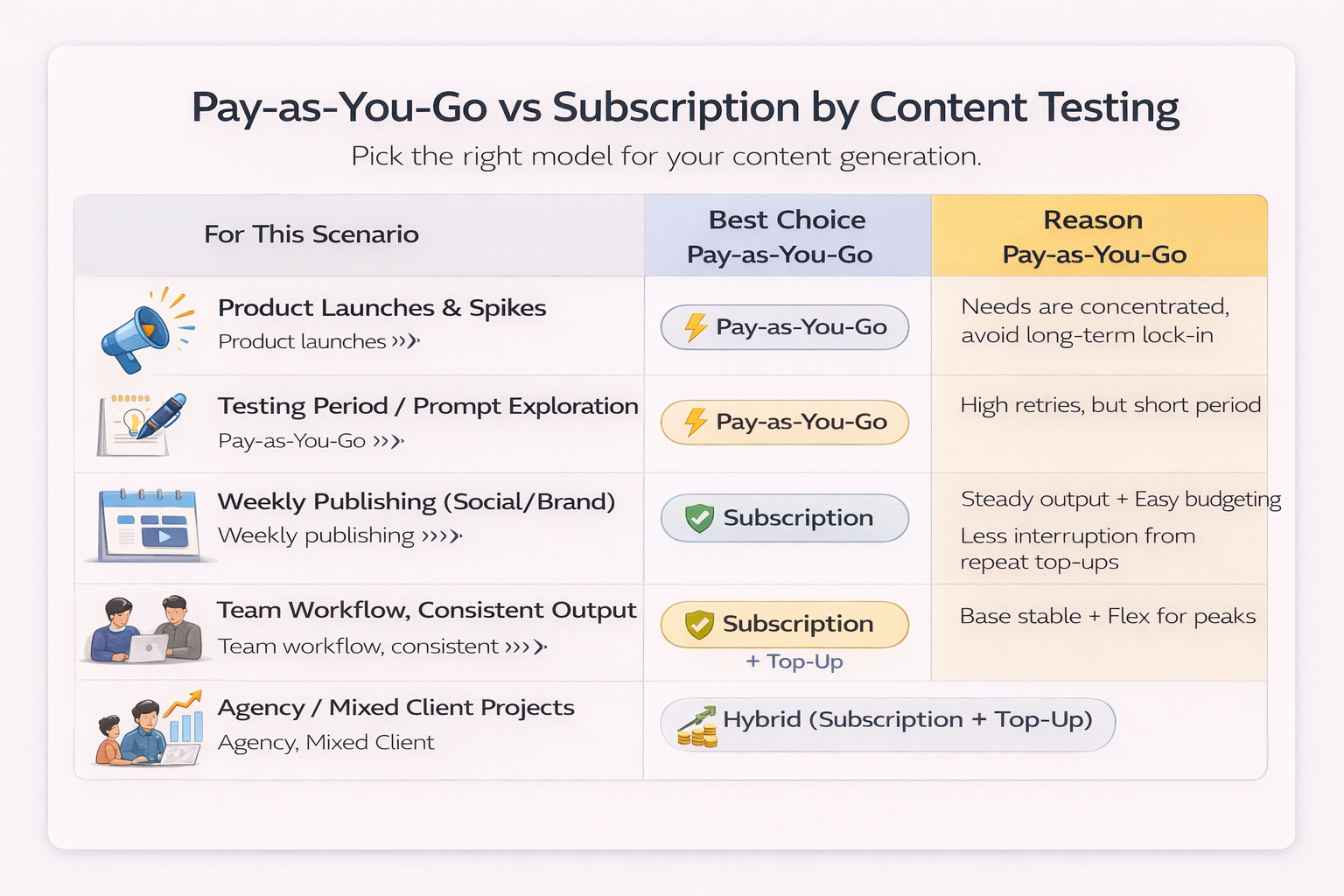
Step-by-Step: Choose the Right Pricing Mode
Use this 4-step method.
- Estimate your real monthly generations.
- Add expected retry volume (prompt iterations).
- Mark whether demand is stable or bursty.
- Choose model: flexible credits or recurring subscription.
Quick Decision Rule
- If your workload changes heavily month to month, start with Pay-as-You-Go.
- If your production is steady and repeatable, move to Subscription.
This simple rule keeps your seedance pricing aligned with reality.
Use Case A: Solo Creator With Irregular Projects
You may post intensively during launches, then slow down for weeks.
In this case, Pay-as-You-Go usually works better because:
- you buy when needed,
- you avoid fixed monthly pressure,
- you can increase spend only during campaign windows.
Recommended seedance pricing approach:
- Start with one top-up package.
- Run one to two campaign cycles.
- Review actual credits usage and retry behavior.
- Upgrade only after stable demand appears.
Use Case B: Small Team Publishing Weekly
If your team publishes every week, Subscription often gives better operational predictability.
Why this seedance pricing model fits:
- easier budget planning,
- consistent output capacity,
- less interruption from frequent repurchase decisions.
Recommended process:
- Set weekly clip targets.
- Estimate retry rates by content type.
- Match plan to average monthly load.
- Keep a small credit buffer for spikes.
Use Case C: Agency-Style Burst Production
Agencies often have mixed client schedules.
A hybrid seedance pricing strategy is usually strongest:
- subscription for baseline delivery,
- pay-as-you-go credits for deadline spikes.
This avoids both under-capacity and over-commitment.
What Actually Drives Cost (Beyond Clip Count)
Many teams underestimate one key factor: iteration density.
A serious seedance pricing calculation includes:
- first-pass generation volume,
- revision rounds,
- failed or rejected creative directions,
- per-project experimentation needs.
Two teams can publish the same number of final videos while using very different generation volume.
A Practical Planning Worksheet
Before committing to any seedance pricing model, answer these five questions:
- How many final clips do we publish monthly?
- How many generation attempts per final clip?
- Which content type needs most retries?
- Which weeks are highest pressure?
- How often do we pause production completely?
These questions usually reveal the right model quickly.
Common Mistakes in Pricing Decisions
Mistake 1: Choosing plan by marketing headline
Fix: choose based on your workflow data.
Mistake 2: Ignoring retry behavior
Fix: include retries in monthly estimates.
Mistake 3: No monthly review cycle
Fix: evaluate usage once per month and adjust.
Mistake 4: Treating all video types equally
Fix: split by content type (ads, explainers, social clips).
A strong seedance pricing strategy is dynamic, not one-time.
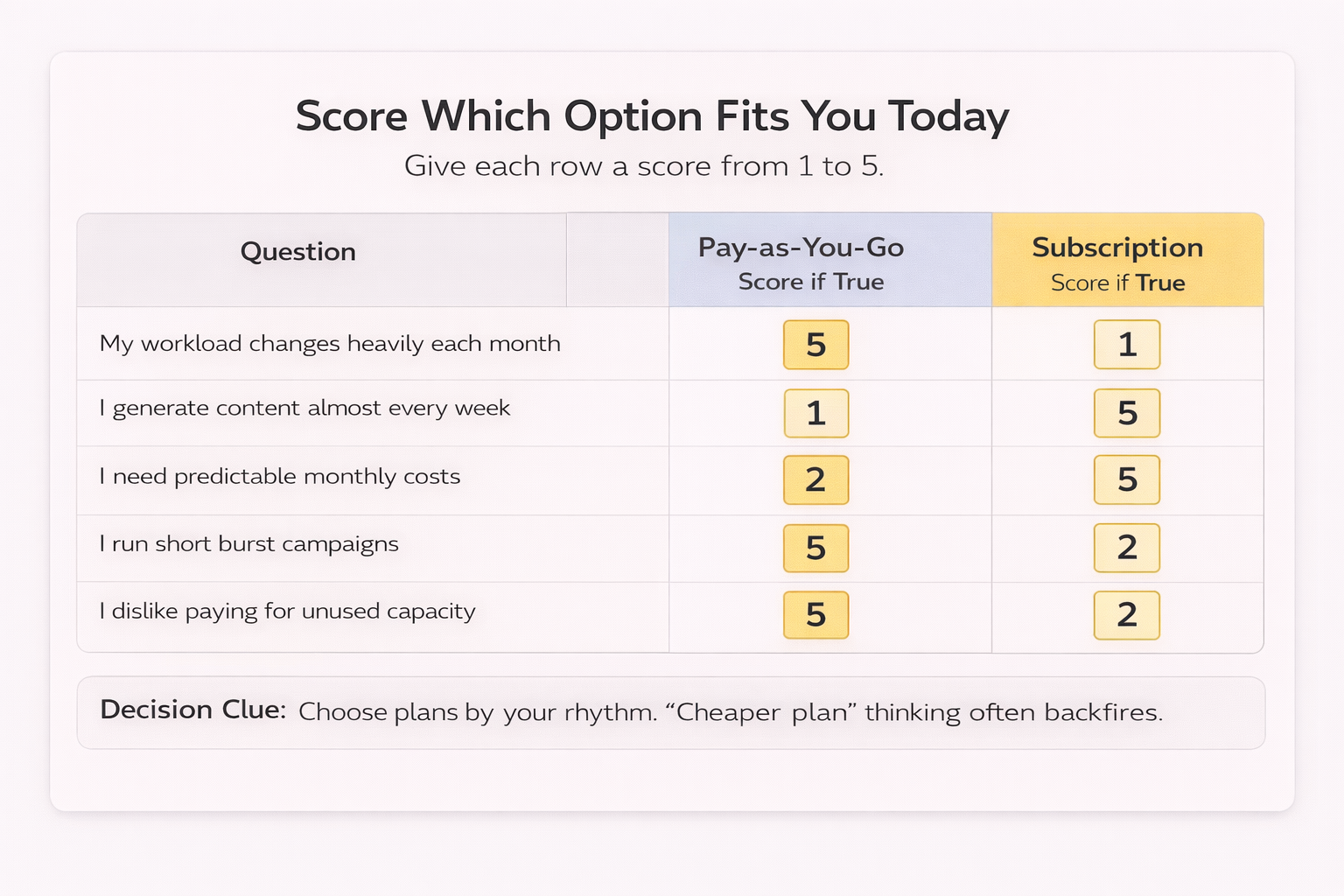
Simple Scorecard: Which Option Fits You Today?
Give each line a score from 1 to 5.
| Question | Pay-as-You-Go score if true | Subscription score if true |
|---|---|---|
| My workload is irregular | 5 | 1 |
| I publish every week | 1 | 5 |
| I need predictable monthly cost | 2 | 5 |
| I run burst campaigns | 5 | 2 |
| I prefer flexible spending control | 5 | 2 |
Add your scores.
- Higher Pay-as-You-Go score: start with top-up mode.
- Higher Subscription score: start with recurring plan.
- Close scores: use hybrid strategy.
This scorecard makes seedance pricing decisions much less emotional.
30-Day Optimization Loop
Use this short loop after your first plan choice.
- Track actual generations weekly.
- Track retry-to-final ratio.
- Track weeks with credit pressure.
- Compare against your initial estimate.
- Adjust plan for next month.
This keeps your seedance pricing aligned with production reality instead of assumptions.
Practical Scenario Planning (Copy and Use)
To make seedance pricing decisions faster, use one of these ready scenarios and adjust numbers for your own workload.
Scenario 1: Launch Month Creator
You are preparing one product launch and need high output for two weeks, then low output.
Planning approach:
- Set a campaign window (for example, 14 days).
- Estimate heavy-generation period separately from low activity period.
- Use Pay-as-You-Go as your default mode for this cycle.
- Re-evaluate after campaign week two.
Why this works:
- Your seedance pricing stays flexible during uncertain demand.
- You avoid locking into recurring cost before pattern stability appears.
Scenario 2: Weekly Publishing Brand
You publish every week and need predictable throughput.
Planning approach:
- Define monthly output target by content type.
- Estimate average retries per content type.
- Use Subscription as baseline capacity.
- Keep small top-up reserve for occasional spikes.
Why this works:
- Your seedance pricing remains predictable.
- Operations spend less time on payment decisions and more time on production quality.
Scenario 3: Mixed Client Production
You handle variable client projects with uneven demand.
Planning approach:
- Separate baseline retained clients from unpredictable one-off work.
- Map baseline load to subscription capacity.
- Use Pay-as-You-Go for project surges.
- Review quarterly for model rebalance.
Why this works:
- A hybrid seedance pricing setup prevents both overpaying and under-capacity.
90-Day Upgrade and Downgrade Rules
Many teams delay plan changes too long because they have no explicit rules.
Use these thresholds:
- Upgrade rule:
- if you hit capacity pressure for 2 consecutive months, move up one level.
- Downgrade rule:
- if utilization stays low for 2 consecutive months, scale down.
- Hybrid rule:
- if baseline is stable but campaigns create spikes, keep subscription + top-up.
These rules make seedance pricing decisions objective and easier to explain to stakeholders.
Budget Communication Template (For Teams)
If you need internal approval, use this short summary format:
Current mode: [Pay-as-You-Go / Subscription / Hybrid]
Observed monthly pattern: [stable / bursty / mixed]
Retry intensity: [low / medium / high]
Primary recommendation: [mode + reason]
Fallback strategy: [what to do if demand changes]
Review date: [next monthly review date]
This turns seedance pricing from opinion into a clear operational decision.
15-Minute Pricing Setup Checklist
If you are choosing today, use this quick seedance pricing setup:
- Open your last 30 days of production notes.
- Count publishable outputs and total generations.
- Mark whether demand looked stable, bursty, or mixed.
- Pick one model for next 30 days only (do not over-plan).
- Set a review date now.
Why this helps:
- Your seedance pricing choice becomes testable.
- You avoid analysis paralysis.
- You can improve plan fit monthly with real data instead of guesses.
One more practical rule: never commit pricing decisions based on your busiest week or your slowest week. Use average behavior across at least 30 days. That keeps seedance pricing choices realistic and protects your workflow from overreaction. A stable decision process is usually more valuable than chasing short-term “perfect” optimization.
FAQ
Is Pay-as-You-Go only for beginners?
No. It is useful for any irregular or campaign-driven workflow.
Is Subscription always cheaper long-term?
Only when your volume and cadence are stable enough to use it consistently.
Should teams avoid Pay-as-You-Go?
Not necessarily. Many teams use it as a burst buffer even with subscription.
How often should I review plan fit?
Monthly is practical for most creators and small teams.
What is the biggest pricing mistake?
Ignoring retries and only counting final published videos.
Recommended Next Steps
- Start generating now
- Read the 5-element prompt method
- Use timeline prompting for cleaner outputs
- Compare available plan options
Final Takeaway
The best seedance pricing choice is the one that matches your real production rhythm.
If your usage is irregular, start flexible. If your usage is steady, plan recurring. If your usage is mixed, use hybrid.
Next step: Choose your best pricing mode and test one month
Disclaimer: This site is an independent product and is not an official Seedance service. Generated outputs may vary based on prompt quality, model behavior, and policy constraints.
Categories
More Posts

Seedance Workflow: History, Credits, and Repeatable Production
Build a reliable Seedance workflow with practical steps for generation history, credit control, and repeatable production routines for creators and small teams.

Seedance Timeline Prompt: Control 5s and 10s Clips Precisely
Learn a practical Seedance timeline prompt method for 5-second and 10-second clips with clear timing blocks, copy-ready templates, and fast debugging steps.

Seedance Product Ad Video: From Feature List to Conversion Script
Learn a practical Seedance product ad video workflow to turn product features into clear 5s and 10s ad scripts that are easier to test, iterate, and convert.